


“Boards today operate in a World where Risk is fast, complex, and interconnected. The old Model of Governance—forms, checklists, and procedural correctness—cannot keep pace. Value-based Evaluation is not a luxury; it is a survival tool.”
Boards are increasingly moving away from Compliance-driven, tick-box Evaluations toward value-based models that emphasise Behavioural Dynamics, Culture, Strategic oversight, AI readiness, Risk Management, and Leadership quality. This transition is prompted by evolving Regulatory Standards, heightened Investor scrutiny, increased societal attention to Governance failures, and the growing complexity of AI, Cybersecurity, and Geopolitics.
Many Boards unknowingly allow external Compliance Indexes, Governance scorecards, and checklist-driven frameworks (from ratings agencies, Governance Bodies, Proxy Advisers, or Consultants) to dominate their evaluation approach.
While these frameworks can be useful for baseline Compliance, they do not generate the insights required to improve Board Effectiveness across areas such as Challenge and Debate, Risk Oversight, Culture Governance, Chair–CEO dynamics, AI/Digital oversight, Strategic depth, and Psychological Safety. Any Board seeking to improve their Effectiveness and be recognised as a high-performing Board must move beyond Compliance-driven structures and create the conditions for value-based evaluation, framing the evaluation as developmental, not judgemental.
“The most successful Boards lean into insight, not into routine. They recognise that Governance is a verb—not an annual questionnaire.”
Boards and Chairs persisting with tick-box approaches risk Governance blind spots, diminished challenge quality, weaker Strategic insight, and Reputational harm.
There are limitations to Tick-Box Evaluations. They typically rely on generic questionnaires, lack Behavioural and Cultural analysis, provide superficial commentary on Risk and Strategy, and fail to assess AI/Digital readiness. They offer limited Stakeholder engagement and rarely follow up on previous actions, and while meeting formal requirements do not enhance Governance or Board Effectiveness.
The Tick-box approach typically does not identify Behavioural Risks (e.g., Dominance, Groupthink, suppressed challenge, low psychological safety), ignores Emerging Risks (AI, Cyber, algorithmic bias), and can mislead Boards into overestimating their Effectiveness, fostering Complacency.
“Tick-box Evaluations confirm comfort. Value-based Evaluations reveal truth.”
There are a range of drivers for Value-Based Evaluations; Regulators now expect deeper assessments of Board Behaviour, Culture, Decision Quality, and Digital Oversight. Investors demand evidence of Challenge, Diversity of thought, AI readiness, and credible Succession Planning. Recent Governance failures highlight the inadequacy of procedural reviews alone. Boards must now address algorithmic risks, challenge AI-driven decisions, oversee Cyber Resilience and anticipate Technological Disruption.
The characteristics of Value-Based Evaluations are assessment and review of Behavioural Dynamics, Strategic Effectiveness, AI and Digital oversight, Risk appetite, Culture, Leadership quality, Committee Synergy, and Succession Planning. It delivers targeted improvement themes, measurable outcomes, capability-building plans, role clarity, and enhanced Risk oversight.
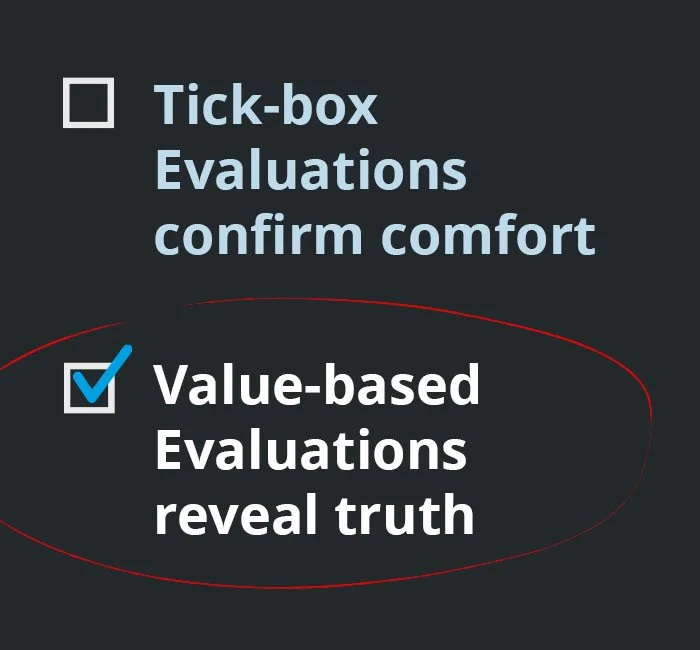
“Tick-box Evaluations achieve Compliance; value-based Evaluations build Capability, Resilience, and Trust.”
There is a superficial attraction and ease in tick-box methods for their simplicity and low friction, but this increases the risk of Governance failure, weakens Regulatory confidence, erodes Investor trust, and exposes the Organisation to Reputational and Crisis vulnerabilities. Chairs who avoid deeper Evaluation may be seen as resistant to Challenge and Change and misaligned with NomCom and Shareholder expectations. Reputational impact considerations are now integral to an Organisation’s Social License, and a Value-based Evaluation is more likely to deliver Board Effectiveness improvements which enhance a Company’s Reputation.
“A strong Chair wants insight, not reassurance.”
Outdated Tick-box Evaluations are old fashioned, high-risk, and inadequate for today’s Business environment. As we seek to improve and develop the landscape of Board Effectiveness Value-based Evaluations provide richer insights, are more aligned with Regulatory and Investor expectations, better identity of Behavioural Risks, and are essential for modern Governance.